


Every week, a new platform emerges, promising to be the ultimate solution for content creators, marketers, and business owners. But after a while, they all start to sound the same: “Generate high-quality content in seconds!”
I’ve tested my fair share of these tools, from versatile LLMs like Claude AI to more specialized platforms. So, when I came across Anyword, I was admittedly skeptical. Was this just another AI writer in a crowded market, or is Anyword the best AI writing tool for performance-driven content creation? Or did it have something genuinely different to offer?
After putting it through a series of hands-on tests, I can tell you this: Anyword is different. It’s not just about AI writing; it’s about generating AI content that performs. And it does this with a feature that genuinely surprised me: a data-backed Performance Prediction score.
In this in-depth Anyword review, I’ll walk you through my experience with the Anyword AI platform. We’ll explore:
If you’re a marketer looking for an AI tool to improve your content creation process and make data-driven decisions, this Anyword review is for you. Let’s dive in.
At first glance, Anyword looks like many other AI writing tools. Anyword is an AI-powered copywriting platform designed to help marketers create content that converts. It has a clean dashboard, a variety of templates for different content types (ads, emails, blogs, social media), and the ability to generate text from a prompt. But the magic of this AI writing tool isn’t just in its ability to write—it’s in its ability to predict.
Anyword’s core differentiator, and a key feature of Anyword, is its Predictive Performance Score. This isn’t just a fancy gimmick; it’s a data-driven feature that forecasts how well a piece of copy will perform before you publish it. As I discovered during my testing, this score is compared against a massive dataset of tens of thousands of real-world A/B tested ads, giving it a level of credibility that’s hard to ignore.
As one user on Medium put it, “Anyword isn’t a writer, it’s a predictor.” [1] This perfectly encapsulates its value proposition. While other AI platforms focus on generating creative or grammatically perfect text, Anyword’s AI focuses on a single, crucial metric for marketers: results. This is where the power of this generative AI tool truly lies.
This makes it clear who Anyword is built for: marketing professionals and teams who need to make data-driven decisions. Anyword is a platform for the demand generation manager who needs to optimize ad spend, the email marketer who needs to improve open rates, and the content strategist who needs to justify their content’s ROI. Anyword also offers solutions for sales teams and agencies. It’s less for the solo blogger or creative writer and more for the marketer who lives and breathes analytics.
To give Anyword a fair review, I couldn’t just look at its features—I had to get my hands dirty. I signed up for a free trial and created a fictional company to work with:
Here’s my experience with Anyword across four key tests. I will show you how to use Anyword to generate different types of content.
This was the most important test. Could Anyword’s signature feature really predict which ad copy would perform best? I wanted to see if I could use Anyword to generate high-performing ad copy from scratch. I prompted it to create five Facebook ad variations for the Mindful Mugs subscription box.
After I provided some initial details, Anyword asked a series of clarifying questions about the product’s unique value, special offers, and pricing. This was impressive—it showed the platform was actively trying to gather context to create better, more specific copy.
The results generated by Anyword were fascinating.
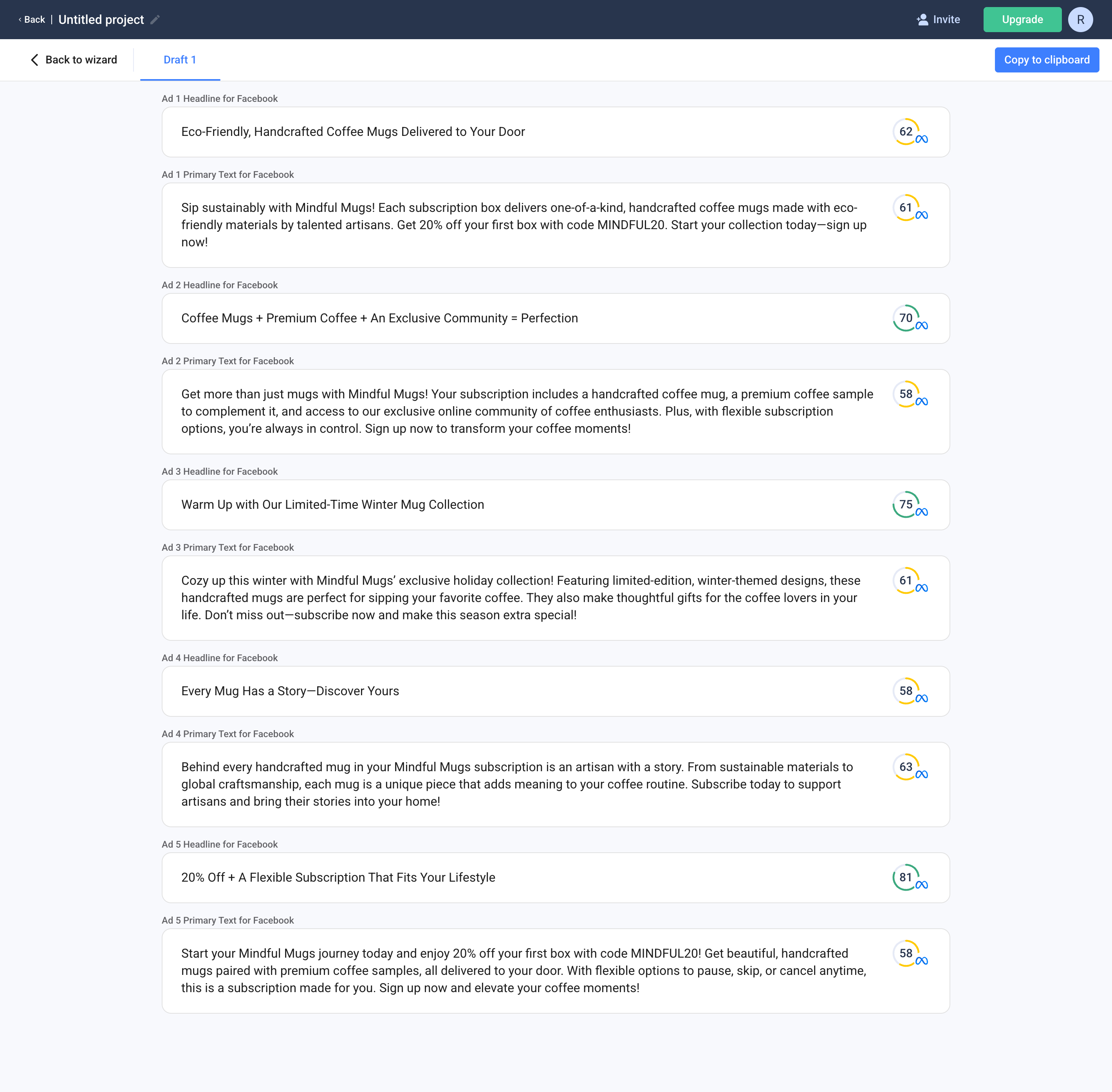
As you can see, the performance scores ranged significantly, from a high of 81 to a low of 58. The highest-scoring ad (81) combined a direct offer with a message of flexibility:
“20% Off + A Flexible Subscription That Fits Your Lifestyle”
In contrast, the lowest-scoring ad (58) took a more emotional, storytelling approach:
“Every Mug Has a Story—Discover Yours”
This suggests that for this type of ad, Anyword’s data favors a direct, benefit-driven message over a purely emotional one. When I clicked the “Insights” link, Anyword revealed that the score of 81 meant the copy was predicted to perform better than 81% of over 22,560 similar texts in its dataset. That’s a powerful piece of data to have before spending a single dollar on ad campaigns.
Next, I wanted to see how the Anyword AI writer handled a full-length blog post. I used its guided workflow to create a 1,500-word article titled “The Rise of Artisanal Coffee Mugs: Why Your Morning Coffee Deserves a Better Home.”
The process was impressive. Anyword guided me through a 6-step workflow: Brief → Title → Outline → Facts & Statistics → Generation. It even provided performance scores for the title options, helping me choose the one most likely to attract readers.
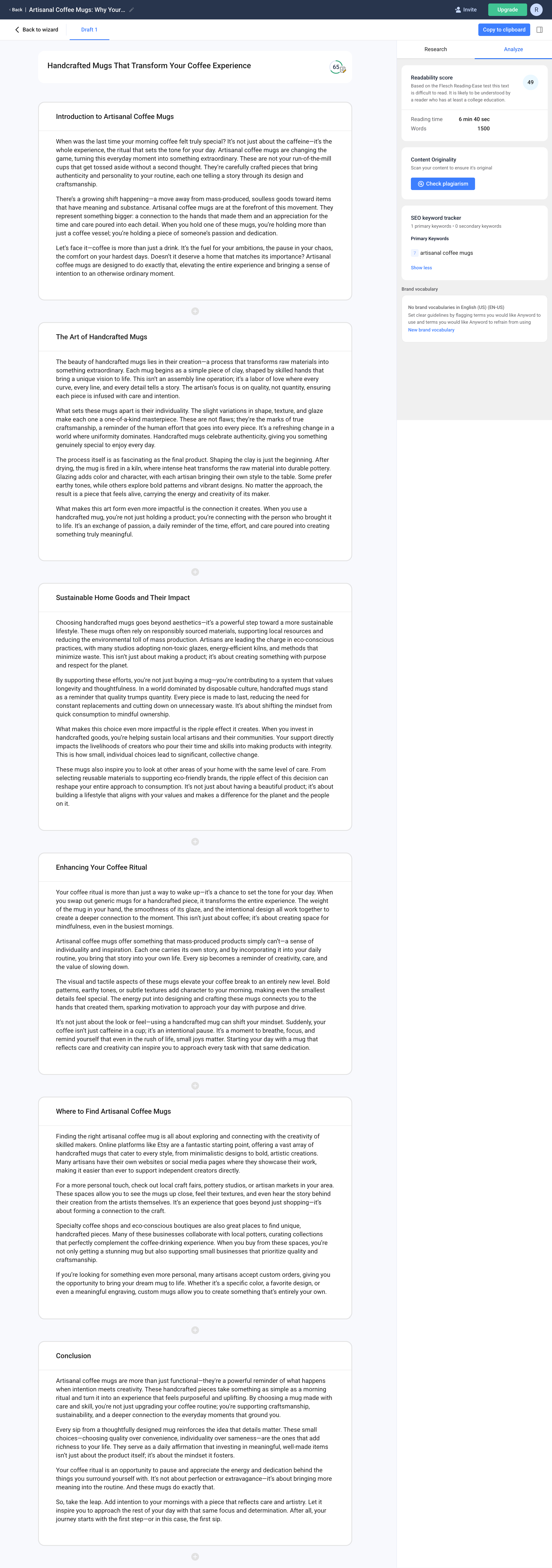
The final AI content was well-structured, and the Anyword blog builder did a good job of incorporating the primary keyword. It maintained a consistent “Motivator” tone throughout its 1,585 words. It was a solid B+ effort—a great starting point, but it lacked the nuance and unique insights of a human writer. It felt a bit generic in places and would need a human touch to elevate it to A+ quality. This is where combining tools comes in handy; you could take this solid foundation and enhance it with a more creative AI like Claude AI or optimize it further with an SEO tool like SurferSEO.
This feature of Anyword is a practical tool for any marketer. I fed it a piece of bland, uninspired copy:
“We sell coffee mugs. They are good quality and look nice. You can buy them on our website. Sign up for our subscription box to get a new mug every month.”
I let Anyword “Make it more engaging,” and the results were a dramatic improvement.
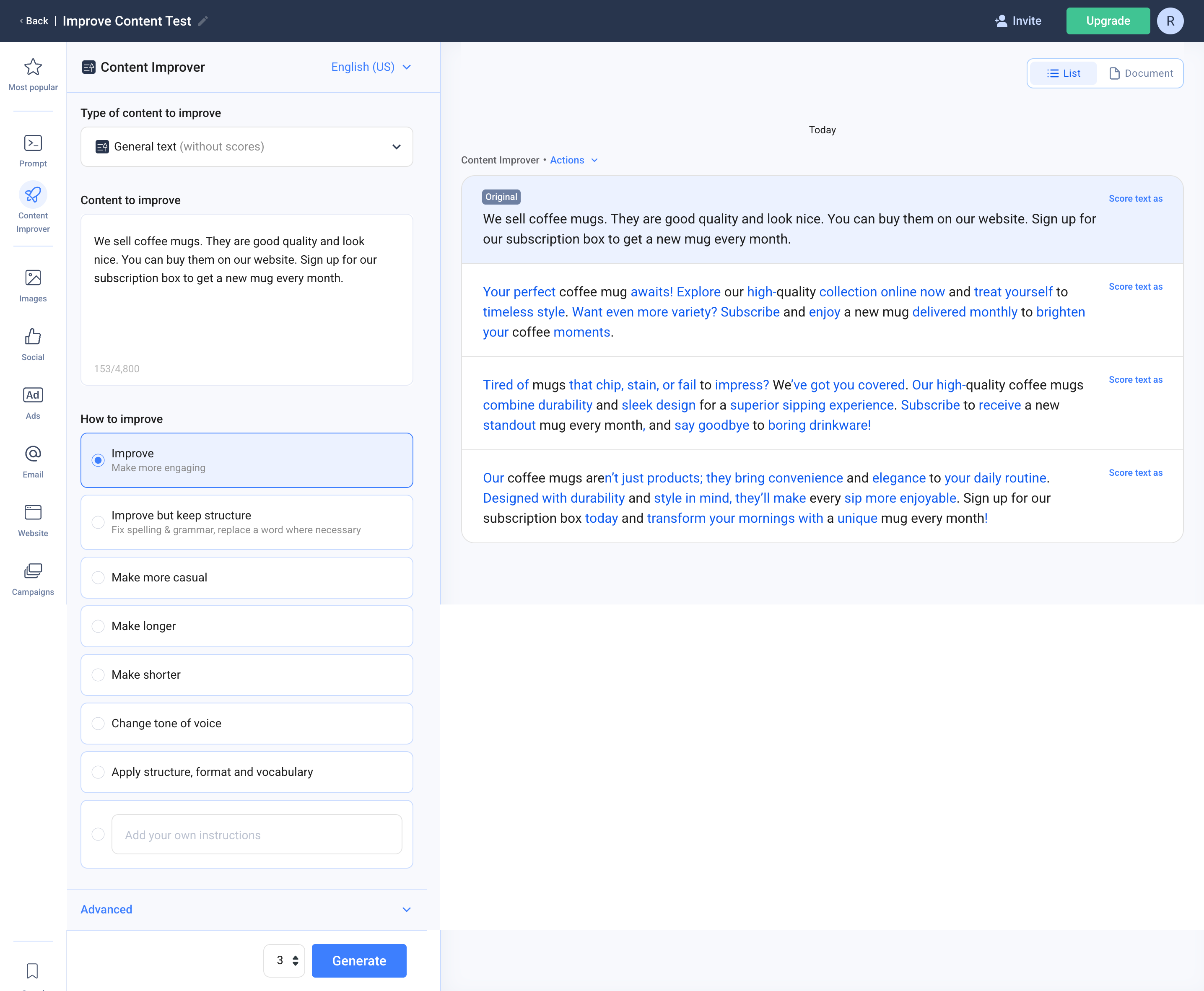
Here’s one of the improved versions:
“Tired of mugs that chip, stain, or fail to impress? We’ve got you covered. Our high-quality coffee mugs combine durability and sleek design for a superior sipping experience. Subscribe to receive a new standout mug every month, and say goodbye to boring drinkware!”
Anyword transformed the bland original into compelling, benefit-driven copy that addressed customer pain points. While this feature didn’t provide performance scores in the free trial, the qualitative improvement was undeniable.
Finally, I tested Anyword’s social media capabilities to create content for an Instagram post. Not only did it generate several caption options with performance scores, but it also generated a unique AI image to go with each one.
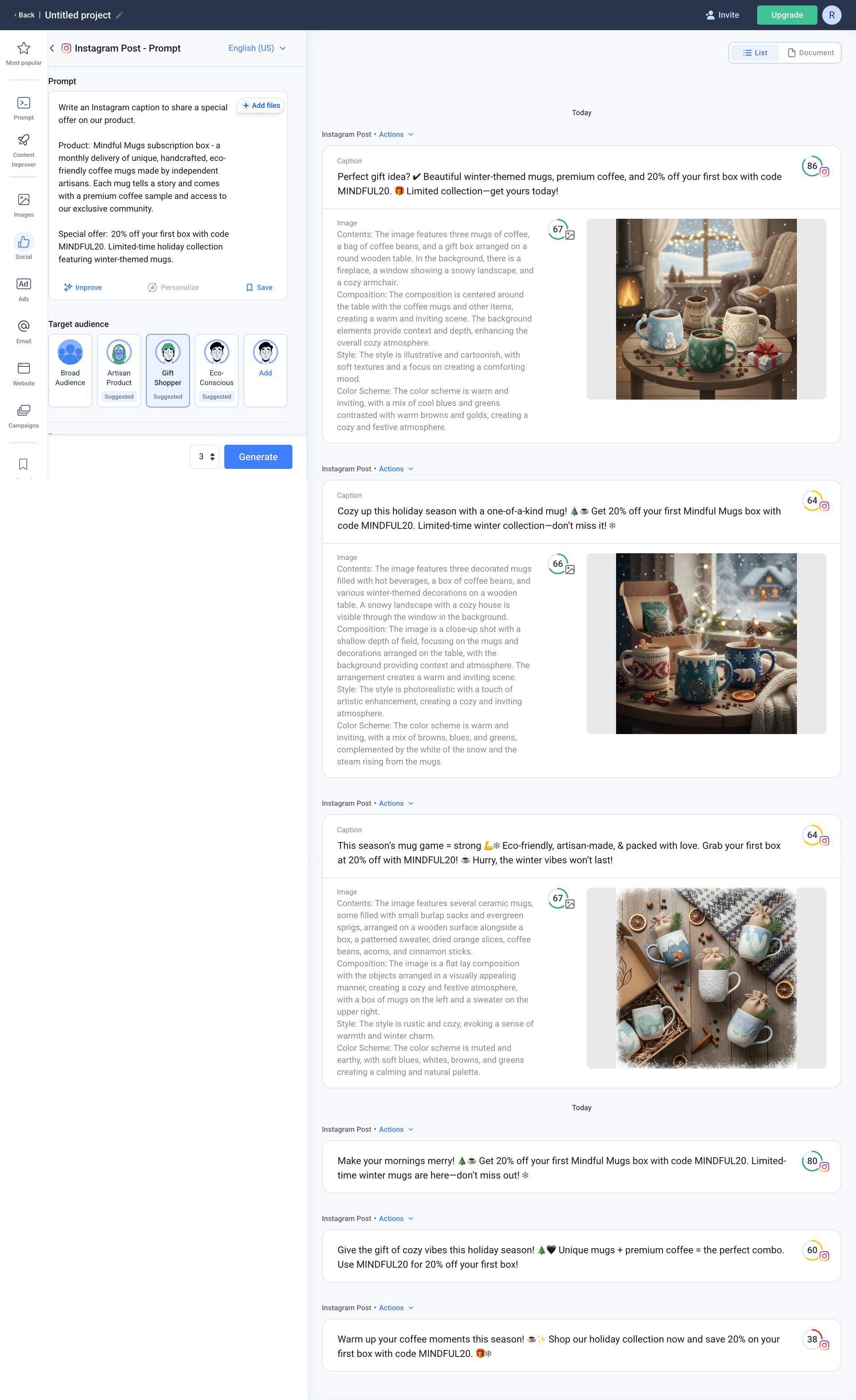
The highest-scoring caption, with an impressive score of 86, was short, benefit-focused, and used emojis effectively:
“Perfect gift idea! 🎁✨ Beautiful winter themed mugs, premium coffee, and 20% off your first box with code MINDFUL20. 🎁 Limited collection—get yours today!”
This test highlighted Anyword’s strength as a comprehensive AI marketing tool. Anyword provides everything you need to create and optimize your social media campaigns. It didn’t just write the copy; it provided a performance prediction and created the visual asset, streamlining the entire social media workflow.
Based on my testing, here’s where the Anyword tool truly shines:
Anyword’s pricing plans reflect its focus on professional marketers and teams. While there is a free trial, the plans are geared toward those who will use the tool regularly for business purposes.
(Pricing as of December 2025)

The 7-day free trial I used provided 25 performance predictions, which was enough to get a feel for the tool but would be quickly exhausted in a real marketing environment. There is no free plan available. The paid plans offer a more realistic number of predictions for ongoing campaigns.
No AI writing tool is perfect, and Anyword is no exception. When you compare Anyword vs other AI copywriting software, you will find pros and cons for each. Here are a few areas where I found it lacking:
So, is Anyword worth the investment? My answer is a resounding yes—for the right person.
On a scale of 1 to 10, I’d give Anyword a 7.5. It doesn’t generate the absolute best content, and its AI images aren’t going to win any art awards. But that’s not the point of Anyword. The genius of this AI tool is that it provides something far more valuable to a marketer: clarity.
It answers the question that keeps marketers up at night: “Will this work?”
If you’re a marketing professional or part of a team that needs to make decisions based on data, I would recommend Anyword. It’s a powerful asset for any marketing team. It bridges the gap between content creation and performance analytics, allowing you to optimize your copy before you launch. In a world where every marketing dollar counts, that’s a superpower.
However, if you’re a solo creator on a tight budget or someone who prioritizes creative prose over conversion rates, you might find it to be overkill. The best approach, in my experience, is to use a combination of AI tools. You can use Anyword to create and optimize your ad copy, and then use another AI writing tool to enhance your long-form content. Use Anyword to choose a high-performing headline and ad copy, use a more creative AI to flesh out a blog post, and use an SEO tool to fine-tune it for search engines.
Ultimately, Anyword has carved out a unique and valuable niche for itself in the crowded AI landscape. It’s not just another AI writer; it’s a predictor, a data analyst, and a strategic partner for any marketer who is serious about results. Anyword is one of the best AI copywriting tools for performance-driven marketing.


